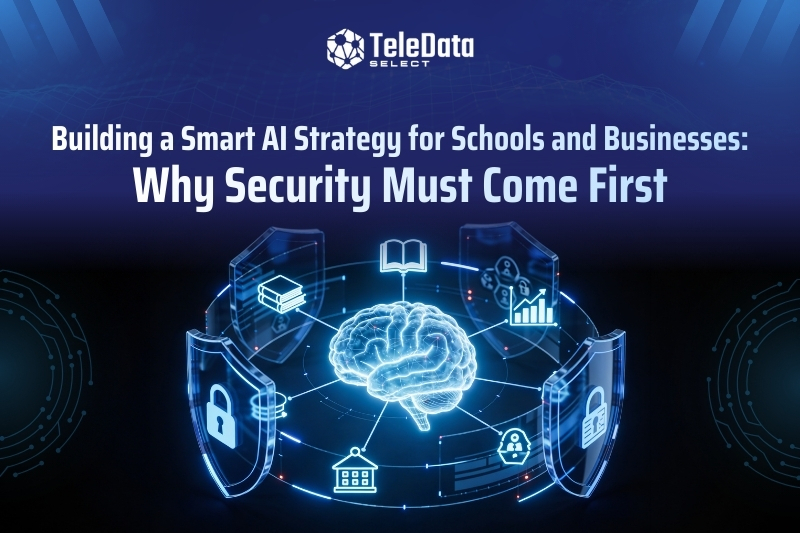
Artificial Intelligence is no longer experimental. Schools are using AI to support instruction, automate administrative work, and enhance student services. Businesses are deploying AI for customer engagement, analytics, automation, and decision-making.
But as AI adoption accelerates, so do the risks.
Looking ahead to 2026, organizations that succeed with AI will be the ones that build security, governance, and strategy together—not separately. Whether you’re a school district, higher education institution, or a growing business, the question is no longer if you’ll use AI, but how safely and responsibly you’ll do it—with the help of managed security solutions.
The AI Security Landscape: What’s Coming in 2026
Understanding where AI security is headed helps schools and businesses make better decisions today.
1. AI-Powered Attacks Are Accelerating
Cybercriminals are now using AI themselves. Expect to see:
- Highly personalized phishing and social engineering attacks
- Adaptive malware that changes behavior to avoid detection
- Deepfake-driven fraud targeting finance teams, administrators, and executives
For schools and businesses alike, this raises the stakes around identity protection and data integrity, making managed security solutions essential.
2. A Rapidly Expanding Attack Surface
AI systems are becoming targets themselves.
- Models, APIs, and AI workflows are now entry points for attackers
- AI-enabled IoT and edge devices introduce additional vulnerabilities
Any AI strategy must account for what data is exposed, where it lives, and who can access it.
3. The Rise of Agentic AI
AI agents capable of making autonomous decisions are becoming more common.
- These systems can act without human approval
- Risks include privilege misuse, unmonitored actions, and unintended consequences
Strong governance and clearly defined guardrails are essential.
4. Zero Trust Evolves (Zero Trust 2.0)
Zero Trust is no longer just about users and devices.
- AI-driven identity verification
- Continuous risk assessment
- Privacy-enhancing technologies (PETs) to support compliance requirements like FERPA, HIPAA, GDPR, and CMMC
For schools and regulated industries, this evolution is critical.
5. Automated Remediation Becomes the Norm
Security teams can’t keep up manually.
- Automated detection and remediation are becoming standard
- Organizations are building custom AI security tools to manage threat volume and speed
6. Collective Defense and Shared Intelligence
AI-enabled threat intelligence sharing across ecosystems allows for faster, more coordinated responses—especially important for education and public-sector environments.
What a Strong AI Strategy Looks Like with Managed Security Solutions
A successful AI strategy balances innovation, security, compliance, and usability.
1. Lead with Security as a Business Enabler
AI security shouldn’t be framed as fear-based risk mitigation. Instead, it should be positioned as:
- A way to protect sensitive data
- A faster path to safe AI adoption
- A method for maintaining trust with students, parents, customers, and stakeholders
Secure AI enables innovation—it doesn’t slow it down.
2. Start with Readiness and Risk Assessment
Before deploying AI tools, organizations should ask:
- How are AI models, data, and workflows secured today?
- Who has access—and should they?
- Are there “shadow AI” tools already in use by staff or students?
An AI security readiness assessment can uncover gaps in identity, governance, and compliance before they become problems.
3. Build Guardrails with Zero Trust and AI Policies
Effective AI strategies include:
- Role-based access to AI systems and data
- Clear policies on data usage, retention, and sharing
- AI-specific governance aligned with Zero Trust principles
This is especially important in education environments with strict data privacy obligations and requires strong managed security solutions.
4. Simplify Through Integration
Schools and businesses are overwhelmed with tools.
The goal should be:
- Fewer platforms
- Better integration across cloud, network, and security operations
- Unified visibility instead of siloed dashboards
AI should reduce complexity—not add to it.
5. Focus on Practical, Real-World Use Cases
Successful AI adoption isn’t theoretical. Strong examples include:
- AI-driven threat detection and response
- Fraud prevention and identity verification
- Secure AI chatbots for student services or customer support
- Automated compliance reporting
These use cases become more effective when supported by managed security solutions.
6. Plan for Ongoing Governance and Monitoring
AI is not “set it and forget it.” Organizations need:
- Continuous monitoring of AI behavior
- Automated incident response
- Regular policy and access reviews
For many schools and businesses, managed security solutions provide the expertise and consistency needed long-term.
7. Educate Stakeholders on Emerging Risks
Leadership teams, IT staff, and end users all need awareness of:
- Deepfake threats
- Agentic AI risks
- AI supply chain vulnerabilities
Education is a critical layer of AI security.
A Simple AI Strategy Conversation Checklist
When planning AI initiatives, start with these questions:
- How are we securing AI models, data, and workflows today?
- Where could AI increase efficiency without increasing risk?
- How do we stay compliant as AI use grows?
Then:
- Share a real ROI example (cost savings, faster response, reduced risk)
- Pilot AI tools with built-in security guardrails
- Plan for managed oversight and continuous improvement using managed security solutions
Final Thought: AI Strategy Is a Leadership Issue
For schools and businesses, AI strategy is about more than technology. It’s about trust, responsibility, and long-term success.
Organizations that treat AI security as a foundation—not an afterthought—will be better positioned to innovate safely, comply confidently, and scale intelligently.
As AI continues to evolve, leadership teams must take a proactive approach by aligning innovation with risk management. This means investing in the right tools, building strong governance frameworks, and ensuring that security is embedded at every stage of AI adoption.
By leveraging managed security solutions, organizations can gain the visibility, control, and expertise needed to manage emerging threats while maintaining operational efficiency.
With the right partner like TeleData Select, businesses and educational institutions can confidently implement secure, scalable AI strategies tailored to their unique needs.
In a rapidly changing digital landscape, those who prioritize security alongside innovation will not only reduce risk but also create a competitive advantage—ensuring sustainable growth and long-term resilience.
FAQs
1. What are managed security solutions and why are they important for AI?
Managed security solutions are services that provide continuous monitoring, threat detection, and risk management. They are essential for AI because they help protect sensitive data, ensure compliance, and reduce security risks in real time.
2. How do managed security solutions help schools and businesses?
Managed security solutions help organizations secure AI systems, prevent cyber threats, maintain compliance, and ensure safe adoption of new technologies without increasing operational complexity.
3. What are the biggest AI security risks for organizations?
The biggest risks include AI-powered cyberattacks, data breaches, deepfake fraud, unauthorized access, and vulnerabilities in AI models, APIs, and connected systems.
4. Why is Zero Trust important in AI strategy?
Zero Trust ensures that every user, device, and system is continuously verified before access is granted, reducing the risk of unauthorized access and improving overall security posture.
5. How can organizations safely adopt AI technologies?
Organizations can safely adopt AI by conducting risk assessments, implementing strong governance policies, monitoring AI systems continuously, and ensuring proper data protection and compliance measures are in place.
 John Hagan, founder and CEO of TeleData Select, leads a managed IT and data company based in Atlanta, GA, serving clients across the US and internationally. The company uses a hybrid collaboration team model that leverages a network of technology providers to help businesses find the right IT solutions at the best prices. TeleData Select offers complimentary telecom audits and assistance with managed IT projects to help businesses stay ahead in the evolving tech landscape.
Feel free to call us direct at 404-439-4480, email or book time with John Hagan through this link today to have a conversation.


0 Comments